

Culture Index's Generative AI Policy: A Blockbuster Moment
Culture Index issued a Generative AI Policy banning AI use with their system. We break down what this means for consultants and forward-thinking leaders.
Remember when Blockbuster executives laughed off Netflix?
They saw streaming as a passing fad, doubling down on brick-and-mortar stores, late fees, and shelves of physical tapes.
We all know how that ended.
Something similar is happening in the assessment world right now, and it’s not a good look.
Recently, a major player in our space sent their clients a new “Generative AI Policy.” (a portion of it can be seen here) On the surface, it talks about privacy and intellectual property. But read closely, and you see the real message: don’t use AI, don’t even describe our system to modern tools like ChatGPT or Gemini, and only trust what we tell you.
It’s not about protecting privacy. It’s about protecting exclusivity and control.
The Old Guard’s Playbook
For decades, traditional assessment companies have run the same playbook:
- Lock insights behind expensive consultants
- Make reports so complex that only “certified experts” can interpret them
- Create dependency through restricted access to information
- Charge premium fees for basic guidance that should be readily available
This worked for a long time … until AI came along and changed what’s possible.
Now, instead of adapting, they’re doubling down with restrictive policies. It’s like telling customers to keep renting VHS tapes because DVDs are “unreliable” and streaming is “too risky.”
The Real Threat Isn’t AI, It’s Transparency
What legacy companies truly fear isn’t AI itself. It’s what AI enables:
- Transparency
- Accessibility
- Empowered decision-making
When clients can instantly understand their own assessment data and get objective, real-time guidance, the artificial scarcity model collapses.
Imagine investing thousands of dollars in assessments and consulting fees, only to be told you can’t even discuss your own results with the tools your company uses every day to make smarter decisions.
That’s like buying a movie ticket and then being told you’re not allowed to talk about the plot when you get home.
Their Advisors Deserve Better
I genuinely feel for the advisors/consultants caught in the middle of this.
These are smart, strategic professionals who want to serve executives hungry for innovation. But they’re being forced to deliver an outdated message:
“Trust us! But definitely don’t trust the tools that could make you smarter and more efficient.”
It’s a tough sell when their clients are being pushed forward by AI everywhere else in their businesses.
A Different Way Forward
At Aptive Index, we’ve taken the opposite approach. We believe that when leaders understand their people better, everyone wins. That means open, transparent insights, not gatekeeping.
Our AI platform, Aria Chat, blends speed and scale with human judgment. In just the two weeks prior to this post, Aria 2.0 (the newest iteration of our AI) powered over 15 million tokens of usage! Real-world conversations, insights, and strategic guidance flowing to executives and consultants in real time.
And while AI is powerful, it’s not about replacing the human element. It’s about amplifying it. The best decisions happen when technology and people work together.
While legacy companies remain stale, forward-thinking organizations are moving the other direction and leaning into AI to empower leaders and teams like never before.
How Smart Organizations Are Using Aria Chat Today
(And Why Legacy Systems Can’t Compete)
Our clients aren’t just talking about AI, they’re using it to transform how they hire, lead, and build thriving teams.
Here are some of the most powerful (and sometimes surprising) ways they’re leveraging Aria Chat, our AI-powered leadership and people strategy platform:
💼 Better Hiring Decisions – Stop relying on gut instinct.
Aria analyzes assessment data to reveal where candidates will naturally thrive or struggle helping avoid costly hiring decisions.
📝 Personalized Interview Guides – Never ask another generic interview question. Generate custom behavioral interview questions tailored to the role, the team, and the individual candidate.
🤝 Team Building – Build teams with clarity, not guesswork.
See exactly where your team is naturally strong and where critical gaps exist so you can assemble balanced, high-performing groups from day one.
⚡ Fix Dysfunction Fast – Don’t let conflicts drag on.
When two people clash, Aria pinpoints the why behind the tension and gives you step-by-step guidance to repair trust and collaboration quickly.
🎯 Coaching Employees at Scale – Real-time leadership insights.
Leaders use Aria to create personalized coaching plans that match each person’s hardwiring, helping them grow without a one-size-fits-all approach.
🪞 Conflict Resolution – Turn heated conversations into breakthroughs.
Aria guides managers through difficult discussions, providing scripts and strategies to keep conversations productive and outcomes clear.
❤️ Romantic Relationship Cheat Sheets – Yes, really.
Aria isn’t just for work. Some clients even use it to better understand their personal relationships – from marriages to dating – with insights into communication styles and conflict patterns beyond the office.
The Streaming Revolution Is Here
Every industry faces a choice: preserve the past or embrace the future.
Blockbuster clung to control. Netflix embraced accessibility.
In the assessment world, some companies are building walls while others are tearing them down. The future belongs to organizations that trust their clients and consultants with insight, rather than hoarding it behind artificial barriers.
Legacy companies can keep renting out their VHS tapes and threatening customers who ask about streaming.
But the future of assessments?
It’s already streaming – smarter, faster, and on demand.

Quiet Quitting vs Role Misalignment: The Real Cause of Employee Disengagement
Role misalignment, not motivation issues, drives employee disengagement, creating 46% higher failure rates and costing organizations up to 3x salary per misplaced employee.
"Quiet quitting" became the workplace villain of 2022. Everyone had a theory about why employees suddenly stopped caring.
Wrong problem. Wrong solutions.
Quiet quitting wasn't the problem. Misalignment was.
While consultants blamed generational shifts and remote work, the real culprit was hiding in plain sight: We've been putting people in jobs that drain their natural energy every single day.
The Real Employee Engagement Crisis
Every day, millions of employees show up to jobs that fight against their natural wiring.
Picture this: The highly social team member stuck analyzing spreadsheets alone. The detail-oriented perfectionist rushed through sloppy processes. The collaborative decision-maker forced to make unilateral calls.
It's not a motivation issue. It's an energy mismatch.
When someone's core behavioral drives clash with their daily work, every task becomes an uphill battle. What managers see as disengagement is often employees conserving energy just to survive their workday.
The Hidden Cost of Getting It Wrong
The numbers tell a stark story:
- 46% of new hires fail within 18 months
- 80% of employee turnover stems from poor hiring decisions
- Organizations lose 1.5-3x an employee's salary for every bad fit
But financial impact is just the beginning. Role misalignment creates:
- Decreased team productivity
- Increased management burden
- Lower customer satisfaction
- Reduced innovation
- Higher stress-related health issues
Why Employee Engagement Strategies Keep Failing
Most engagement surveys ask the wrong questions: "Do you feel motivated at work?"
Here's the problem. Motivation isn't a personality trait. It's what happens when someone's behavioral drives align with their work environment.
Two Employees, Same Problem, Opposite Needs
Sarah craves social connection but works in isolation. Mike needs independent focus but faces constant interruptions.
Both score low on engagement surveys. Both need completely different solutions.
The Universal Motivation Myth
Traditional engagement strategies assume everyone responds to the same things:
Open offices → Drain introverted workers
Team-building activities → Exhaust socially depleted employees
Stretch assignments → Overwhelm detail-oriented perfectionists
Autonomy initiatives → Stress employees who prefer clear direction
The result? Programs that help some people while harming others.
People don't need engagement perks. They need roles that don't burn them out.
What Real Employee Engagement Actually Looks Like
True engagement happens when hardwired behavioral patterns align with role requirements.
The high-influence team member who shapes strategy thrives. The precision-driven individual who perfects critical processes excels. The adaptable problem-solver who tackles new challenges stays energized.
Four Key Behavioral Drivers of Natural Engagement
1. Influence Drive
Some employees are energized by shaping outcomes and leading initiatives. Others thrive supporting others' success.
2. Social Energy
Team members either gain energy from collaboration or recharge through independent work.
3. Change Preference
Workers naturally prefer either stable environments or dynamic challenges.
4. Detail Orientation
Individuals are energized by either precision work or big-picture progress.
The Solution: Role-Based Hiring Over Resume-Based Hiring
Smart organizations are moving beyond experience-focused hiring. They're asking different questions:
- What behavioral drives lead to natural success here?
- Which work patterns create energy versus drain it?
- How can we structure roles to leverage natural strengths?
This isn't about lowering standards. It's about putting people where their natural tendencies become competitive advantages.
The Results Speak for Themselves
When employees work in alignment with their behavioral hardwiring:
- 40% reduction in employee turnover
- 3x improvement in productivity metrics
- Decreased stress-related absences
- Increased innovation and problem-solving
- Higher customer satisfaction scores
This creates a positive cycle. Natural engagement drives better results. Better results create more opportunities to work within strengths.
How Managers Can Stop Creating Disengagement
Most managers unknowingly contribute to misalignment. They assume everyone is motivated the same way.
Example: Giving independent projects to highly social team members as "development opportunities." They're actually removing the interactions that energize those people.
Managing Through Behavioral Understanding
Great managers don't try to motivate people. They create conditions where natural motivation emerges.
For High-Influence Team Members:
- Provide leadership opportunities
- Involve them in strategic decisions
- Give authority to drive change
For Highly Social Employees:
- Structure collaborative work
- Create relationship-building opportunities
- Include them in cross-functional projects
For Detail-Oriented Workers:
- Allow time for thorough analysis
- Provide clear standards and processes
- Recognize precision achievements
For Change-Adaptable Employees:
- Offer project variety
- Provide flexibility in methods
- Minimize rigid routines
Better Questions = Better Insights
Traditional engagement surveys miss the real issues. Here's how to ask better questions:
Instead of: "Are you engaged at work?"
Ask: "Does your role energize or drain you?"
You're not fixing disengagement by asking if someone feels 'motivated.' You fix it by putting them in a role that actually fits.
Instead of: "Do you feel motivated?"
Ask: "Which parts of your job feel effortless versus exhausting?"
Instead of: "Would you recommend this workplace?"
Ask: "How well does your role match your natural work style?"
Building Assessment Into Your Process
Successful organizations integrate behavioral assessment into:
- Pre-hire evaluation → Screen for role-specific fit
- Onboarding → Understand new employee drives
- Performance reviews → Catch alignment issues early
- Team development → Optimize collaboration
- Succession planning → Match people to fitting roles
The Competitive Advantage of Getting Alignment Right
The quiet quitting phenomenon isn't about declining work ethic. It's a wake-up call about the cost of role misalignment.
Organizations that understand this will gain significant advantages by:
- Hiring for behavioral fit, not just skills
- Designing roles around natural strengths
- Managing individuals according to their drives
- Measuring alignment alongside engagement
Imagine This Workplace
Picture an organization where most employees wake up energized about their workday. Their responsibilities align with their natural behavioral patterns.
Where quiet quitting becomes irrelevant because people work in positions that fuel rather than drain their energy.
This isn't wishful thinking. It's the predictable result of understanding that engagement comes from alignment, not motivation programs.
Your Next Steps as a Leader
Ready to address the real cause of disengagement? Start here:
- Audit current team dynamics → Identify potential misalignments
- Implement behavioral assessment → Understand team members' core drives
- Redesign problem roles → Modify positions with chronic engagement issues
- Train managers → Help leaders understand individual differences
- Measure alignment → Track role fit alongside engagement metrics
The Bottom Line
The quiet quitting conversation reveals a fundamental truth: Employee engagement isn't about motivation. It's about alignment.
You don't fix quiet quitting with surveys. You fix it by putting the right people in the right roles. Full stop.
Organizations that figure this out first will build cultures where high performance feels natural instead of forced.

The True Cost of Guessing on People: Why Smart Leaders Are Choosing Data-Driven Hiring in 2025
Smart leaders are replacing hiring guesswork with data-driven decisions, reducing costly mis-hires and building high-performing teams through scientific assessment.
Every business leader knows that people are their greatest asset—and often, their greatest expense. But what's less understood is the real financial impact of hiring mistakes, misaligned teams, and underutilized talent.
The organizations thriving today aren't just hiring differently—they're thinking differently about what predicts success. They've moved beyond gut feelings and resume scanning to make people decisions based on data, science, and proven insights about human behavior.
Here's why this shift matters more than ever.
The Hidden Costs of Traditional Hiring
According to SHRM, the average cost of a bad hire is 30% of that employee's annual salary. For a $100,000 role, that's $30,000 in direct costs—before factoring in team disruption, lost productivity, or missed opportunities.
But the real expense isn't just the obvious failures. It's the slow drain of:
- Talented people in misaligned roles who underperform despite their capabilities
- Teams that struggle to collaborate because they don't understand each other's working styles
- High-potential employees who leave because they were never in the right fit to begin with
- Projects that stall because you have smart people working against their natural strengths
These costs compound daily, whether you measure them or not.
The Science of Better Decisions
Modern psychometric science reveals something counterintuitive: skills and experience are poor predictors of long-term success. What matters more are the hardwired drives that determine how someone approaches work, processes information, and interacts with others.
These innate attributes—things like the need for influence, preference for social interaction, drive for consistency, or attention to precision—remain stable throughout someone's career. They're the invisible forces that determine whether someone will thrive in a role or merely survive it.
Organizations using attribute-based hiring are seeing:
- 40% reduction in turnover through better role alignment
- 3x productivity improvement when people work in roles that match their natural drives
- 67% increase in employee engagement with proper role and culture fit
The data is clear: when you align people's hardwiring with role requirements, everyone wins.
Beyond Hiring: The Multiplying Effect
While better hiring matters, the real transformation happens after people join your team. When you understand how your people are naturally wired, you can:
Optimize Team Dynamics: Teams that understand each other's working styles collaborate more efficiently, turning potential friction into productive collaboration.
Accelerate Development: Instead of generic training programs, you can provide targeted development that builds on natural strengths while addressing specific growth areas.
Improve Leadership Effectiveness: Leaders who understand their team members' drives can adapt their management style, creating environments where people naturally excel.
Reduce Turnover: People stay longer when they're in roles that energize rather than drain them.
The performance gap between aligned and misaligned teams often determines whether organizations hit their goals or miss them entirely.
The Questions Smart Leaders Are Asking
Progressive organizations aren't asking "How much does better hiring cost?" They're asking:
- How much is team misalignment costing us in missed opportunities?
- How many talented people have we lost because they were in roles that didn't fit their natural drives?
- What would 10% better execution across our teams be worth to our bottom line?
- How do we build competitive advantage through our people, not just our products?
These leaders understand that in today's environment, every hire matters. Every team must deliver. Every investment must drive measurable impact.
The Technology That Makes It Possible
Modern assessment platforms combine rigorous science with practical application. The best solutions provide:
- Scientifically Validated Measures: Using factor analysis and statistical validation to ensure reliability
- Role-Specific Targeting: Matching candidates to the specific behavioral requirements of each position
- Team Optimization Tools: Understanding how different drives interact and complement each other
- AI-Powered Insights: Translating complex data into actionable guidance for leaders
This isn't about adding complexity—it's about adding clarity to the most important decisions you make.
The Competitive Advantage in Plain Sight
You wouldn't manage finances without dashboards. You wouldn't make strategic decisions without data. Yet many organizations still manage their most important asset—their people—based on intuition and hope.
The competitive advantage goes to organizations that understand this shift and act on it. When you know how your people are wired, you can design roles, teams, and cultures that bring out their best work.
That's not just good for employees—it's transformational for business results.
Making the Investment Decision
The mathematics are straightforward:
- Avoid one mis-hire: Investment positive
- Retain one key employee longer: Investment positive
- Help one team execute 10% more effectively: Investment positive
But the real value compounds over time. Better hiring leads to better teams. Better teams deliver better results. Better results create sustainable competitive advantage.
The Future of Work Is Data-Driven
Smart leaders recognize that the future belongs to organizations that make people decisions based on science, not assumptions. They're investing in tools and approaches that help them:
- Hire for potential, not just past performance
- Build teams with complementary strengths
- Develop people based on their natural drives
- Create cultures where everyone can thrive
This isn't about following trends—it's about building sustainable competitive advantage through your greatest asset: your people.
For leaders who are serious about scaling with intention and building consistently high-performing teams, understanding what drives human behavior has moved from "nice to have" to "essential for success."
The question isn't whether this approach works—the data proves it does. The question is whether you'll be among the leaders who embrace it early or those who catch up later.
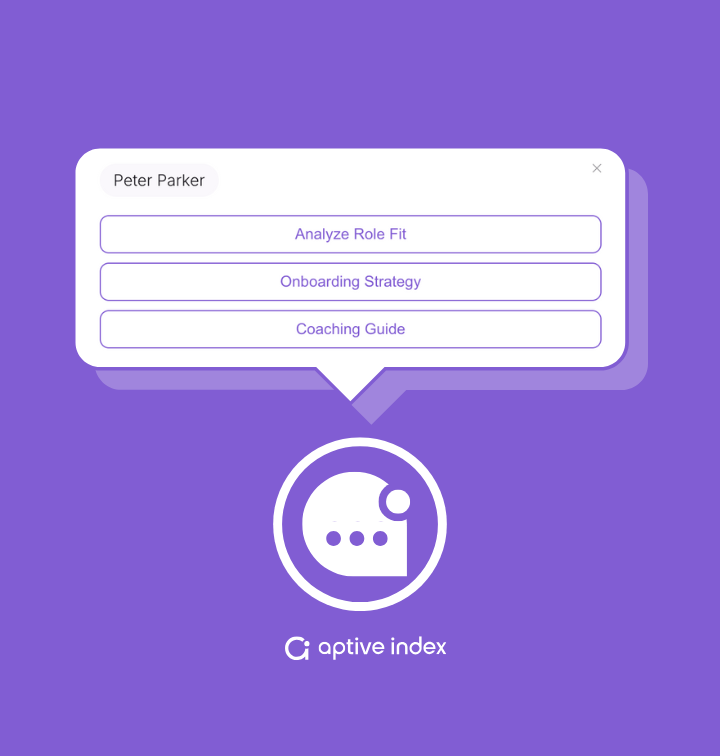
Why Aptive Index Goes Beyond Traditional Psychometric Hiring Tools
While traditional assessment tools only address hiring decisions, Aptive Index provides complete talent optimization including team dynamics, leadership development, and AI-powered coaching throughout the employee lifecycle.
When it comes to hiring the right talent, tools like Predictive Index (PI) and Culture Index (CI) have become staples for many organizations. These psychometric assessments help companies align candidates with job requirements, offering insight into natural behavior patterns and cognitive tendencies.
However, while effective for talent acquisition, they only address a fraction of what companies truly need to build high-performing teams. Traditional hiring insights represent just 30% of what organizations actually need for sustainable workforce success.
The Evolution Beyond Hiring-Only Tools
Aptive Index represents the next generation of psychometric platforms, doing everything PI and CI accomplish, then extending far beyond traditional boundaries. The remaining 70% of organizational value lies in what happens after the hire: optimizing current employees, accelerating team effectiveness, and unlocking leadership potential.
Advanced Hiring Capabilities (30% of Value)
Like Predictive Index and Culture Index, Aptive Index benchmarks candidates against role-specific attribute targets. These targets, based on stable innate drives rather than situational personality traits, help ensure job fit and predict engagement, performance, and employee retention.
Aptive Index's hiring advantages:
8 core attributes for comprehensive candidate evaluation, including nuanced traits like Emotional Resonance, Abstraction, and Prosocial Drive
More targeted behavioral interview questions that probe genuine fit
Reduced hiring bias by focusing on innate drives rather than personality projections
EEOC-compliant assessment methodology with proven reliability
This precision enables more accurate candidate matching and significantly reduces costly mis-hires that traditional tools often miss.
The True Differentiator: Complete Talent Optimization (60% of Value)
Most psychometric tools end their value proposition at the hire. Aptive Index treats hiring as just the beginning of comprehensive talent optimization.
Decode Team Dynamics
Visualize exactly how team members complement or clash based on their behavioral profiles and attribute combinations. Understanding these dynamics transforms team friction into productive collaboration, leading to:
Better cross-functional collaboration and communication
Reduced workplace conflict and improved team cohesion
Enhanced team performance through optimized working relationships
Strategic team composition for critical projects and initiatives
Balance Execution Styles
Understand whether your team naturally leans toward systems or standards, detail-oriented or big-picture thinking, adaptability or routine preferences. This insight helps you design workflows that leverage rather than fight against natural tendencies.
Identify Leadership Potential
Move beyond charisma or tenure to see who's genuinely wired to lead in different contexts. Whether it's a visionary Enterpriser or steady Coordinator, match leadership opportunities to authentic strengths for:
More effective succession planning and leadership development
Better organizational performance through aligned leadership roles
Reduced leadership failures from poor role-person fit
Strengthen Trust and Communication
Using Aptive Index's Trust Framework, leaders and team members learn how their attributes shape trust expectations and collaboration styles. This creates stronger working relationships and more effective team communication.
Precision Coaching and Development
One-on-one guides and relationship analyses help managers tailor communication and feedback to how each team member is naturally wired, resulting in more effective performance management and targeted professional development.
Built-in Leadership Intelligence (10% of Value)
Aptive Index doesn't treat leadership as a personality trait or promotion title. It recognizes leadership as alignment between someone's drives and role demands. Some profiles excel at driving change, while others provide stability, wisdom, and relational strength.
Rather than generic leadership development programs, Aptive Index helps you identify, support, and deploy the right leaders in appropriate contexts.
The Aria AI Advantage: On-Demand Intelligence
What truly differentiates Aptive Index from Predictive Index, Culture Index, and other assessment tools is Aria, our built-in AI assistant that functions as an embedded I/O psychologist, coach, and strategist.
Aria provides:
Instant Profile Interpretation: Complex attribute data translated into clear, actionable insights tailored to your specific role or challenge
Dynamic 1-on-1 Relationship Guides: Practical coaching for better collaboration with any teammate based on both behavioral profiles
Real-time Leadership Coaching: Navigate difficult conversations, motivate diverse teams, and optimize role fit for better outcomes
Smart Hiring Support: From drafting position targets to generating custom interview questions that probe for genuine alignment
Aria transforms raw assessment data into strategic insight, available on-demand with zero delay—eliminating the need for expensive consultant interpretation.
Measurable Business Impact
Organizations using comprehensive talent optimization through Aptive Index report:
40% reduction in employee turnover through better role alignment and team dynamics
3x productivity improvement when people work in roles matching their natural drives
67% increase in employee engagement with proper role and culture fit
Significant reduction in hiring costs and faster time-to-productivity for new hires
Enhanced innovation and problem-solving capabilities across teams
Beyond Traditional Assessment: Complete Platform Integration
While traditional tools require separate solutions for hiring, team development, and leadership programs, Aptive Index integrates everything into one comprehensive platform:
For Hiring Managers: Scientific candidate matching, custom interview question generation, team fit analysis, and optimized onboarding
For Team Leaders: Individual coaching guidance, team dynamics visualization, conflict resolution strategies, and performance management aligned to natural drives
For HR and Leadership Development: Leadership potential identification, succession planning, team restructuring recommendations, and culture development strategies
For Executives: Organizational design insights, strategic team composition for critical initiatives, and comprehensive people analytics
The Competitive Advantage
Organizations that understand the difference between hiring-only tools and complete talent optimization platforms gain significant advantages:
Talent Acquisition: Better candidate attraction and selection through comprehensive behavioral assessment
Employee Retention: Higher retention rates by ensuring people work in energizing rather than draining roles
Team Performance: Optimized collaboration and communication through understanding of team dynamics
Leadership Development: More effective leaders developed and deployed in appropriate contexts
Organizational Culture: Workplace environments where high performance feels natural rather than forced
Making the Strategic Shift
The most successful organizations are moving beyond seeing assessment as a one-time hiring screen to viewing it as ongoing strategic intelligence about their most important asset: their people.
While Predictive Index and Culture Index provide value at the hiring stage, Aptive Index delivers continuous value across the entire employee lifecycle. It equips you not just to hire the right people, but to understand them, coach them, organize them into high-performing teams, and develop them into effective leaders.
With Aria providing instant access to insights, those capabilities are always just one question away.
Ready to move beyond traditional hiring tools? Discover how complete talent optimization can transform your organization's approach to people decisions.

The Myth of the 'Perfect Hire': Why Role Alignment Matters More Than Experience
Experience looks good on paper, but role alignment predicts actual success, explaining why 46% of impressive new hires struggle within 18 months.
You find the candidate.
Flawless resume.
Impressive credentials.
References that sound like fan mail.
You hire them.
Ninety days later, they’re gone.
Or worse, still there, but underperforming.
Sound familiar?
We’ve all been sold the same illusion: that the “perfect hire” exists, and you can find them by skimming for the right buzzwords, schools, and job titles.
Here’s the truth: The perfect hire is a myth. And chasing it is costing you more than you think.
1. The Resume Tells You What They've Done, Not How They'll Work
We've built entire hiring processes around a flawed assumption: that past success in one environment predicts future success in yours.
It doesn't work that way.
A resume shows you what someone has done. It lists skills they've learned and companies they've worked for. But it can't tell you how they're naturally wired to work, which matters far more for long-term success.
Take two candidates with nearly identical backgrounds, same degree, similar experience, comparable skills. Put them in the same role, and their performance will likely be dramatically different.
Why? Because one might be energized by independent problem-solving while the role needs constant collaboration. The other might thrive on structure when your environment demands comfort with ambiguity.
The credentials match perfectly. The natural fit doesn't. And that gap is where 46% of new hires fail within 18 months.
The Better Question:
Instead of "Can they do this job?" The real question is "Will they thrive doing it?"
Skills can be taught. Your systems can be learned. But you can't train someone to be energized by work that drains them.
2. Experience Can't Compensate for Misalignment
We assume experience solves everything. Hire someone with enough years under their belt, and they'll figure it out.
Except they often don't.
Working against your natural wiring is exhausting. It's like being right-handed but forced to use your left hand for everything. You can do it, but it requires constant effort and never feels natural.
When someone's natural drives match what a role requires, something different happens. They don't just work harder, they work more naturally. Tasks that would drain someone else energize them. Problems that would frustrate others engage them.
Organizations tracking this see real differences:
- 40% fewer people leave when natural drives match role requirements
- 3x better productivity compared to misaligned placements
- 67% higher engagement when people work in naturally fitting roles
Experience still matters for knowledge and expertise. But alignment determines whether someone will sustain high performance, or burn out trying.
3. The Real Cost Isn't the Salary. It's the Momentum Lost
HR often cites the cost of a bad hire as 1.5 to 3x the annual salary. SHRM estimates it's closer to 500% of annual salary for mid-level roles once you factor in recruiting, onboarding, lost productivity, and team disruption.
But even that number misses something bigger: opportunity cost.
Every day someone is misaligned in a role, you're not just losing money. You're losing momentum. You're losing the compounding gains that come from having someone naturally wired to excel.
Think about the projects that don’t launch. The clients who never close. The innovation that stalls. The team morale that drifts.
The cost isn't just what you're spending, it's what you're missing.
4. “Culture Fit” Isn’t a Personality Match, It’s a Drive Match
Everyone talks about hiring for culture fit. But too often, that gets confused with hiring people who seem familiar or agreeable.
Real culture fit means alignment between how someone is naturally driven to work and what your environment actually demands.
Common Misalignments:
- A brilliant analyst in a relationship-first role
- A structure-driven thinker in a fast-paced, chaotic environment
- A natural collaborator placed in solo project work
None of these are skill issues. They’re energy mismatches. And those mismatches compound over time.
The best organizations don’t guess. They get specific about what drives success in each role, and they assess whether candidates are wired for those dynamics.
5. Building Teams That Actually Work
The perfect hire is a myth. Perfect implies someone who excels across all roles, in all environments, under all conditions. That person doesn’t exist.
But the right hire? That’s real.
That’s someone whose natural drives align with what the role truly demands. Someone who doesn’t have to fight their wiring to succeed. Someone who fits, not just on paper, but in practice.
This Isn’t About Lowering Standards
It’s about getting sharper. More precise. More honest about what truly predicts success in your organization, not what reads well on a resume.
Extraordinary teams aren’t made by collecting top credentials. They’re built by aligning the right people with the right roles and letting their strengths do the work.
The Shift Forward
It starts by redefining what success looks like in each role.
Then it takes the right tools to uncover how candidates are naturally wired—not just what they say in interviews.
And finally, it requires the courage to hire for alignment over familiarity.
The question isn’t whether alignment matters, the data confirms it does.The real question is: Are you ready to stop chasing “perfect” and start hiring for what actually works?