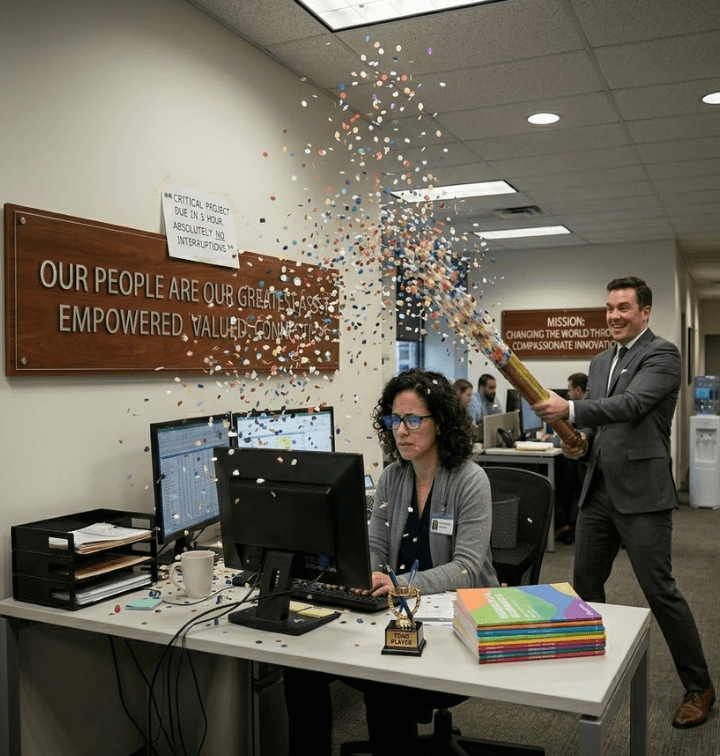
Culture Isn’t a Perk. It’s a Psychological Contract.
Culture isn't what you say matters. It's what people experience consistently enough to believe.
Most organizations say they want a “purpose-driven culture.”
What they often build instead is a branding campaign.
Mission statements get printed on walls. Values show up in onboarding decks. Leaders talk about impact in town halls. Yet employees still disengage, burn out, or quietly disconnect from the organization’s deeper goals.
Why?
Because people don’t commit to purpose simply because it’s communicated. They commit when it aligns with how they are naturally wired to work, contribute, and trust.
That’s the gap many organizations miss.
Culture is not what leaders say matters. Culture is what people experience repeatedly enough to believe. And when purpose becomes disconnected from human motivation, even the best intentions start to feel performative.
The organizations that last understand something different: sustainable culture is built at the intersection of psychology, behavior, and meaning.
Why “Purpose” Often Fails Inside Organizations
Many leaders assume culture problems are communication problems.
“If employees understood the mission better, they’d be more engaged.”
But behavioral science tells us something more important: humans are motivated less by abstract ideals and more by whether their environment consistently reinforces their innate drives.
That distinction matters.
A highly collaborative employee may feel deeply connected to a culture centered around belonging and team cohesion. Another employee may feel most fulfilled when given autonomy, ownership, and the freedom to solve difficult problems independently.
Both can care about the same organizational mission.
But they experience purpose differently.
This is where many cultures quietly fracture.
Organizations unintentionally create environments that reward only one style of contribution. Over time, people who naturally think, communicate, or execute differently begin to feel misaligned — even when they believe in the mission itself.
The result is predictable:
- Engagement declines
- Trust erodes
- Innovation slows
- Turnover rises
- Culture becomes compliance instead of commitment
Research in organizational psychology consistently shows that employees sustain motivation when three psychological conditions exist:
- They understand how they contribute
- Their work aligns with intrinsic drivers
- They feel psychologically safe expressing those drivers
Without those conditions, purpose becomes aspirational language disconnected from daily experience.
The Hidden Psychology Behind Meaningful Cultures
Purpose-driven organizations are not built by hiring people who “fit the culture.”
They are built by understanding the diverse motivational systems already inside the organization.
At Aptive Index, this starts with understanding innate drives rather than personality labels. The assessment measures core motivational attributes like:
- Influence — the need to shape direction and outcomes
- Sociability — the need for connection and belonging
- Consistency — the need for stability and predictability
- Precision — the need for accuracy and standards
These aren’t soft preferences. They shape how individuals experience trust, contribution, recognition, and fulfillment.
For example:
A highly visionary “Eagle” archetype may feel purposeful when building something new, influencing strategy, and driving innovation.
Meanwhile, a structural “Wolf” archetype may experience meaning through creating systems, reliability, and operational excellence that keep the organization functioning smoothly.
Neither contribution is more valuable. But cultures often celebrate one while unintentionally overlooking the other.
That imbalance creates disengagement that leaders frequently misinterpret as performance issues.
In reality, it’s often motivational misalignment.
What Doesn’t Work
Generic Values Statements
Words like integrity, innovation, and collaboration sound meaningful but often fail behaviorally because they’re too abstract.
Different people interpret them differently.
For one employee, “collaboration” means constant brainstorming and open discussion. For another, it means clear communication with minimal interruption.
Without understanding the motivational lens employees bring to those words, organizations create confusion instead of alignment.
Hiring for “Culture Fit”
This is one of the most expensive mistakes organizations make.
When leaders hire for comfort and similarity, they often over-index on one behavioral style. Teams become culturally homogeneous, which feels harmonious initially but weakens adaptability, challenge, and innovation over time.
Strong cultures are not built on sameness.
They are built on complementary strengths.
Purpose Without Systems
Purpose cannot survive in systems that reward contradictory behavior.
An organization cannot preach employee wellbeing while rewarding constant urgency. It cannot claim innovation matters while punishing calculated risk-taking.
Employees trust systems more than slogans.
And trust is fundamentally psychological. According to the Aptive Index Trust Framework, individuals evaluate trust through three dimensions:
- Character — Will they do what they say?
- Competence — Can they deliver?
- Compassion — Do they care about my wellbeing?
Culture erodes when those expectations consistently go unmet.
The Alternative: Designing Culture Around Human Hardwiring
Purpose-driven organizations that last tend to do three things exceptionally well.
1. They Normalize Different Motivational Styles
The healthiest cultures recognize that not everyone contributes the same way.
Some employees energize teams socially. Others stabilize operations. Others challenge assumptions. Others create technical mastery.
High-performing organizations intentionally create space for all of those contributions rather than unconsciously rewarding only the loudest or most visible styles.
This reduces unnecessary friction and helps employees feel psychologically understood.
2. They Build Teams With Complementary Strengths
Behavioral diversity matters strategically.
A team filled entirely with visionary thinkers may generate endless ideas but struggle with execution. A team composed entirely of highly structured operators may execute flawlessly but resist innovation.
The strongest organizations intentionally balance:
- Vision & Possibility
- Strategy & Challenge
- Drive & Delivery
- Systems & Stability
- Knowledge & Mastery
- Connectivity & Energy
Purpose becomes sustainable when organizations value all six forms of contribution.
3. They Make Self-Awareness Operational
Most organizations treat self-awareness as personal development.
The best organizations treat it as infrastructure.
At Aptive Index, this aligns with the Phoenix Framework:
- Data — Understanding behaviors
- Impact — Recognizing effects on others
- Drives — Understanding underlying motivations
The deeper leaders understand the “why” beneath behavior, the more effectively they can build trust, communication, and alignment across teams.
That creates cultures that feel authentic instead of performative.
What This Looks Like in Practice
Consider a fast-growing technology company struggling with burnout and rising turnover.
Leadership believed the issue was workload. But deeper analysis revealed something else: the company’s culture rewarded only high-urgency, high-influence behavior.
Employees who thrived on thoughtful analysis, precision, or structured execution felt chronically undervalued — despite being critical to long-term scalability.
Once leadership understood the motivational imbalance, they made several shifts:
- Meetings became more inclusive of reflective contributors
- Decision timelines allowed space for strategic analysis
- Recognition systems expanded beyond visible leadership behaviors
- Teams were intentionally balanced across working styles
Within months, collaboration improved, trust increased, and retention stabilized.
Nothing about the mission changed.
But employees finally experienced the culture in a way that aligned with how they were naturally wired to contribute.
That’s the difference between performative purpose and sustainable purpose.
Building a Culture That Actually Lasts
Leaders don’t create meaningful cultures through inspiration alone.
They create them by designing environments where different people can contribute meaningfully without abandoning how they naturally operate best.
That requires moving beyond personality stereotypes and surface-level engagement tactics.
It requires understanding the psychological architecture beneath behavior itself.
The organizations that thrive over the next decade will not simply have better missions.
They will have better alignment between:
- purpose,
- people,
- trust,
- and human motivation.
Because culture isn’t built by what’s written on the wall.
It’s built by what people consistently experience every day.
You may also like

What if those advantages are deliberately more favorable than what's offered to those already at the top? What if we created entire systems designed to give extra support, resources, and opportunities to those who are behind?
If you felt a visceral "no" just now, I get it. Such suggestions often trigger immediate pushback about merit, fairness, and earning your way.
But what if I told you that some of America's most beloved and profitable institutions have been doing exactly this for decades? And not only do we accept it - we enthusiastically tune in every week to watch it work?
Welcome to the NFL draft.
Every year, we watch a system that deliberately advantages struggling teams. The Browns don't get told to "pull themselves up by their bootstraps." The Giants aren’t accused of cheating when they get early picks of top talent. Instead, we've built entire structures to ensure that those at the bottom get extra help, additional resources, and preferential access to new opportunities.
And here's the kicker: Look at the Kansas City Chiefs heading into Super Bowl 2025 this Sunday. Despite a system that deliberately gives advantages to struggling teams, the Chiefs are appearing in their fourth Super Bowl in five years. Having systematically lower draft picks hasn't destroyed their ability to excel. They've simply had to continue working hard and making the most of their opportunities - just like everyone else.
Giving advantages to those who are behind doesn't automatically diminish those at the top. The Chiefs aren't losing because other teams get better draft picks. Excellence, merit, and hard work still matter – we've just created a system that gives everyone a better shot at achieving them.
Why? Because we understand something fundamental about sports that we seem to struggle with in other contexts: Sometimes, helping those who are behind lifts up the entire game.
Now, let's be clear - the challenges faced by struggling NFL teams aren't directly comparable to the systemic barriers and historical disadvantages faced by marginalized communities in our society. Professional sports franchises worth billions aren't the same as generations of families who've been denied access to education, housing, or career advancement opportunities. The parallel isn't perfect.
But the principle illuminates something important about how we think about advantage and opportunity. If we can understand that giving struggling teams extra support makes the whole league stronger, why do we resist programs designed to give historically disadvantaged groups better access to opportunity? If we celebrate systematic advantage every Sunday, why do we question it on Monday morning?
I don't claim to have the perfect policy solutions for addressing generations of systemic inequality. These are complex challenges that require thoughtful, nuanced approaches. But what I do know is this: There are people and communities who need us, as a society, to create better pathways to opportunity - not handouts, but real chances to compete and excel. Just as we've done in sports, we can create systems that both maintain high standards and ensure everyone has a fair shot at meeting them.
The timing couldn't be more relevant. As we debate dismantling DEI programs in 2025, millions will gather this Sunday to watch our most profitable sports league showcase a system built on the principle that those with the longest distance to cover need extra support to compete. So perhaps before we rush to declare victory over "unfair" corporate DEI initiatives, we should ask ourselves: If we can cheer for equity on the field, why not in the workplace?

When it comes to hiring the right talent, tools like Predictive Index (PI) and Culture Index (CI) have become staples for many organizations. These psychometric assessments help companies align candidates with job requirements, offering insight into natural behavior patterns and cognitive tendencies.
However, while effective for talent acquisition, they only address a fraction of what companies truly need to build high-performing teams. Traditional hiring insights represent just 30% of what organizations actually need for sustainable workforce success.
The Evolution Beyond Hiring-Only Tools
Aptive Index represents the next generation of psychometric platforms, doing everything PI and CI accomplish, then extending far beyond traditional boundaries. The remaining 70% of organizational value lies in what happens after the hire: optimizing current employees, accelerating team effectiveness, and unlocking leadership potential.
Advanced Hiring Capabilities (30% of Value)
Like Predictive Index and Culture Index, Aptive Index benchmarks candidates against role-specific attribute targets. These targets, based on stable innate drives rather than situational personality traits, help ensure job fit and predict engagement, performance, and employee retention.
Aptive Index's hiring advantages:
8 core attributes for comprehensive candidate evaluation, including nuanced traits like Emotional Resonance, Abstraction, and Prosocial Drive
More targeted behavioral interview questions that probe genuine fit
Reduced hiring bias by focusing on innate drives rather than personality projections
EEOC-compliant assessment methodology with proven reliability
This precision enables more accurate candidate matching and significantly reduces costly mis-hires that traditional tools often miss.
The True Differentiator: Complete Talent Optimization (60% of Value)
Most psychometric tools end their value proposition at the hire. Aptive Index treats hiring as just the beginning of comprehensive talent optimization.
Decode Team Dynamics
Visualize exactly how team members complement or clash based on their behavioral profiles and attribute combinations. Understanding these dynamics transforms team friction into productive collaboration, leading to:
Better cross-functional collaboration and communication
Reduced workplace conflict and improved team cohesion
Enhanced team performance through optimized working relationships
Strategic team composition for critical projects and initiatives
Balance Execution Styles
Understand whether your team naturally leans toward systems or standards, detail-oriented or big-picture thinking, adaptability or routine preferences. This insight helps you design workflows that leverage rather than fight against natural tendencies.
Identify Leadership Potential
Move beyond charisma or tenure to see who's genuinely wired to lead in different contexts. Whether it's a visionary Enterpriser or steady Coordinator, match leadership opportunities to authentic strengths for:
More effective succession planning and leadership development
Better organizational performance through aligned leadership roles
Reduced leadership failures from poor role-person fit
Strengthen Trust and Communication
Using Aptive Index's Trust Framework, leaders and team members learn how their attributes shape trust expectations and collaboration styles. This creates stronger working relationships and more effective team communication.
Precision Coaching and Development
One-on-one guides and relationship analyses help managers tailor communication and feedback to how each team member is naturally wired, resulting in more effective performance management and targeted professional development.
Built-in Leadership Intelligence (10% of Value)
Aptive Index doesn't treat leadership as a personality trait or promotion title. It recognizes leadership as alignment between someone's drives and role demands. Some profiles excel at driving change, while others provide stability, wisdom, and relational strength.
Rather than generic leadership development programs, Aptive Index helps you identify, support, and deploy the right leaders in appropriate contexts.
The Aria AI Advantage: On-Demand Intelligence
What truly differentiates Aptive Index from Predictive Index, Culture Index, and other assessment tools is Aria, our built-in AI assistant that functions as an embedded I/O psychologist, coach, and strategist.
Aria provides:
Instant Profile Interpretation: Complex attribute data translated into clear, actionable insights tailored to your specific role or challenge
Dynamic 1-on-1 Relationship Guides: Practical coaching for better collaboration with any teammate based on both behavioral profiles
Real-time Leadership Coaching: Navigate difficult conversations, motivate diverse teams, and optimize role fit for better outcomes
Smart Hiring Support: From drafting position targets to generating custom interview questions that probe for genuine alignment
Aria transforms raw assessment data into strategic insight, available on-demand with zero delay—eliminating the need for expensive consultant interpretation.
Measurable Business Impact
Organizations using comprehensive talent optimization through Aptive Index report:
40% reduction in employee turnover through better role alignment and team dynamics
3x productivity improvement when people work in roles matching their natural drives
67% increase in employee engagement with proper role and culture fit
Significant reduction in hiring costs and faster time-to-productivity for new hires
Enhanced innovation and problem-solving capabilities across teams
Beyond Traditional Assessment: Complete Platform Integration
While traditional tools require separate solutions for hiring, team development, and leadership programs, Aptive Index integrates everything into one comprehensive platform:
For Hiring Managers: Scientific candidate matching, custom interview question generation, team fit analysis, and optimized onboarding
For Team Leaders: Individual coaching guidance, team dynamics visualization, conflict resolution strategies, and performance management aligned to natural drives
For HR and Leadership Development: Leadership potential identification, succession planning, team restructuring recommendations, and culture development strategies
For Executives: Organizational design insights, strategic team composition for critical initiatives, and comprehensive people analytics
The Competitive Advantage
Organizations that understand the difference between hiring-only tools and complete talent optimization platforms gain significant advantages:
Talent Acquisition: Better candidate attraction and selection through comprehensive behavioral assessment
Employee Retention: Higher retention rates by ensuring people work in energizing rather than draining roles
Team Performance: Optimized collaboration and communication through understanding of team dynamics
Leadership Development: More effective leaders developed and deployed in appropriate contexts
Organizational Culture: Workplace environments where high performance feels natural rather than forced
Making the Strategic Shift
The most successful organizations are moving beyond seeing assessment as a one-time hiring screen to viewing it as ongoing strategic intelligence about their most important asset: their people.
While Predictive Index and Culture Index provide value at the hiring stage, Aptive Index delivers continuous value across the entire employee lifecycle. It equips you not just to hire the right people, but to understand them, coach them, organize them into high-performing teams, and develop them into effective leaders.
With Aria providing instant access to insights, those capabilities are always just one question away.
Ready to move beyond traditional hiring tools? Discover how complete talent optimization can transform your organization's approach to people decisions.

Most people meet Aria through a professional lens. They use it to hire smarter, align teams, or lead more effectively. But what surprises users is how quickly those insights carry over into their personal lives.
The same behavioral science that builds high-performing teams can also help you become a more thoughtful spouse, parent, and family member. Because once you stop guessing why people behave the way they do, everything changes.
When people first discover Aria, Aptive Index’s AI assistant, they usually think about work: hiring, team alignment, leadership development. And Aria excels at that.
But something unexpected happens. The same insights that improve professional collaboration begin to reshape personal relationships. The behavioral intelligence that builds high-performing teams also helps partners reconnect, parents understand their children, and families heal long-standing tensions.
Decode Communication Breakdowns with Your Spouse
You’ve had that same argument again and again. Different topic, same pattern.
One of you needs details before acting; the other wants to focus on the big picture.
Neither is wrong. You’re simply wired differently.
How Aria Bridges Communication Gaps
When both partners complete the Aptive Index assessment, Aria creates a custom Relationship Guide explaining why your conversations derail and how to get them back on track.
Maybe your high Influence drive makes you visionary and fast-moving, while your spouse’s high Precision makes them detail-oriented and cautious. Aria translates these differences into actionable communication strategies, specific phrases, timing cues, and conversational structures that help you both feel heard.
Result: fewer circular arguments, more understanding, and deeper emotional connection.
Unlock Better Parenting Through Behavioral Awareness
Parenting tests every ounce of patience and empathy. What works brilliantly for one child can fail completely with another and that’s because every child is wired differently.
Understanding Each Child’s Drives
Aria helps you decode your children’s unique behavioral patterns.
- A high Sociability child thrives on connection and shared decisions.
- A low Sociability child needs quiet independence.
- A high Consistency child craves structure and predictability.
- A low Consistency child flourishes with flexibility and change.
Ask Aria real-world parenting questions like:
- “Why does my son resist the structure that helps his sister thrive?”
- “How can I motivate each child effectively?”
Aria tailors guidance to each child’s drives, so you know when to step in, when to back off, and how to parent each personality authentically.
Understanding Yourself as a Parent
Aria also helps you understand your own tendencies as a parent. Maybe your natural Precision makes you strict about rules, while your child’s Influence thrives on freedom. Recognizing those mismatches early lets you adjust before conflict patterns harden.
Navigate Family Dynamics with Clarity and Compassion
Family patterns run deep. Decades of history, unspoken expectations, and personality clashes can make even simple interactions complex.
Making Sense of Recurring Patterns
Aria helps you understand why certain family members clash while others connect effortlessly.
Your brother’s low Prosocial drive might make him seem self-focused but it’s not lack of care, it’s natural independence. Your mother’s high Emotional Resonance explains why she takes things to heart.
Ask Aria questions like:
- “Why do my sister and I keep having the same argument?”
- “How should I approach my father about difficult topics?”
Aria provides targeted strategies to reduce defensiveness, foster empathy, and create productive dialogue.
Build Deeper Trust in Your Marriage
Trust means different things to different people and that’s why it’s often misunderstood.
Aria’s Trust Framework
Aria reveals that people evaluate trust through three core dimensions:
- Character – Will they do what they say?
- Competence – Can they deliver quality?
- Compassion – Do they genuinely care?
Your spouse’s highest drives determine which trust dimension matters most.
- High Consistency = reliability builds trust.
- High Precision = competence matters most.
- High Emotional Resonance = compassion feels essential.
Rebuilding Trust with Precision
When trust breaks, couples often invest in the wrong area, showing compassion when the partner needs competence, or reliability when they crave emotional attunement. Aria pinpoints which trust “currency” your spouse values and gives actionable strategies to rebuild it quickly and effectively.
Develop Self-Awareness That Changes Everything
The most transformative insight from Aria isn’t about others, it’s about you.
Understanding Your Own Patterns
Through conversational coaching, Aria helps you uncover blind spots and emotional triggers:
- “Why do I struggle with certain personalities?”
- “Why does this situation drain me so much?”
- “Why do I keep attracting the same conflicts?”
You’ll understand what energizes or exhausts you, what motivates your reactions, and how to bridge differences more effectively.
The Ripple Effect
When you know your own wiring, you naturally communicate better, manage stress, and resolve conflicts faster. Aria helps you express yourself without defensiveness and interpret others’ behavior without judgment.
The Personal Transformation Users Don’t Expect
Most people start using Aria for work. They stay because it changes their lives.
The same behavioral insights that drive performance at work can deepen love, strengthen families, and heal relationships. Users often share that the most meaningful breakthroughs come not from team alignment but from finally understanding their spouse, connecting with their kids, and repairing family patterns.
Access Relationship Guidance Anytime
Aria offers on-demand, personalized insights, no waiting rooms, no scheduling.
- 2 AM after an argument? Ask what might have triggered it.
- Parenting challenge? Get guidance tailored to each child’s profile.
- Dreading a family event? Prepare with insights into likely dynamics.
While Aria isn’t a replacement for therapy, it delivers immediate, evidence-based strategies grounded in behavioral science.
The Advantage of Understanding What Drives Behavior
The question isn’t if understanding drives transforms relationships, it’s how fast your relationships change once you do.
Imagine having instant, data-driven insights into every important relationship in your life.
- What conversations would finally click?
- What misunderstandings would disappear?
- What connections would deepen?
Aria brings validated behavioral science into every relationship, helping you show up with clarity, empathy, and authenticity wherever life takes you.
Stop Guessing. Start Understanding.
At work or at home, the key to better relationships isn’t more effort, it’s better insight.
Aria brings behavioral science to your most personal relationships, not through generalized advice, but through real data about who you are and what you need.
It helps you communicate clearly, connect intentionally, and navigate conflict with more confidence.
That’s the shift: from reaction to clarity. From guessing to knowing.
Discover how Aria’s AI relationship coaching turns behavioral data into real human connection - at work, at home, and everywhere in between.