Your Best Player Probably Shouldn't Be Your Captain

Articles
July 23, 2026

Before you name a captain, ask: Who does the group orient around when things get hard? That's where real leadership actually lives.

Picture the scene: a packed film room, a roster full of talent, and a coaching staff trying to figure out where to put the "C." Almost always, the answer comes back to the same player. The one who fills the silence. The one whose voice carries.

It's an understandable instinct. It's also frequently wrong.

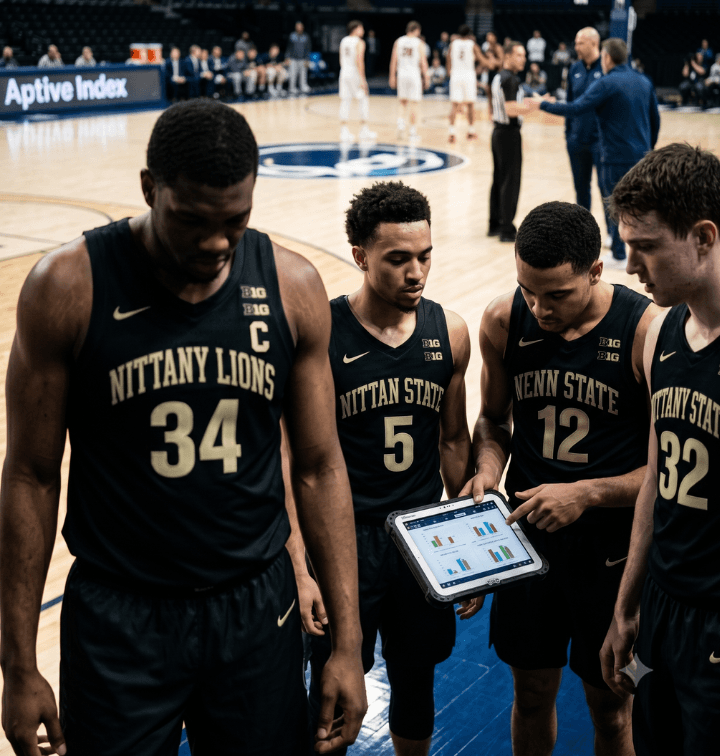
Aptive Index recently completed behavioral mapping on a back-to-back conference champion basketball program — 31 wins, 5 losses, the best sustained record in its conference's history. What the data showed was quietly counterintuitive. The team's two best players didn't fit the traditional leadership mold. The point guard's profile read as a low-assertiveness connector, not a floor general who commands the huddle. The highest-energy starter, the one most coaches would hand the room to, happened to be the weakest shooter on the roster. The head coach's own emotional-processing score sat at the very bottom of the scale.

On paper: a leadership deficit. On the court: one of the most precisely aligned teams in the sport that season.

Leadership Doesn't Always Announce Itself

There's an old distinction in leadership research between authority you're given and influence you earn. Most leaders already sense this. What behavioral data adds is visibility into how that earned influence actually moves through a group.

When Aptive mapped this roster across core behavioral dimensions, the data didn't show an absence of leadership. It showed leadership running through a channel most coaches aren't trained to look for.

The team's most productive players were structured, consistent, and allergic to noise. They didn't campaign for the room. They demonstrated a standard — possession after possession — until the rest of the roster started orienting around them without being told to. We call this gravitational leadership: influence that accumulates through visible reliability, not declared authority.

The point guard's profile followed the same pattern. Rather than a ball-dominant player imposing a personal style, the data described a "reads the room" archetype — someone whose value comes from sensing what the defense is willing to give up and delivering the ball there. That's not a compromise at the position. It's the job description, once you understand what the job actually requires.

Even the team's weakest shooter carried the highest prosocial-drive score on the roster — a measurable pull toward group outcomes over individual ones. His contribution never showed up in the box score. It showed up in whether the team held together when the score wasn't going their way.

Where Most Programs Get It Wrong

The instinct most teams follow is simple: find the most assertive, highest-usage player, and hand them the room. It's an easy shortcut, because assertiveness is visible — and visibility gets mistaken for capability.

But push a high-precision, low-assertiveness player into a loud, "alpha" leadership style, and you don't create a leader. You create friction. You burn energy the player would rather spend executing.

The same mistake happens constantly off the field. Leaders who assume influence has to be loud consistently walk past the person who's already quietly setting the standard everyone else is following.

Finding the Leadership That's Already There

The fix isn't recruiting louder leaders. It's identifying where influence is already flowing and building structure around it on purpose. That means asking different questions: Who does the group orient around when things get hard? Whose consistency is the floor everyone else stands on? Where is emotional and cultural connectivity actually concentrated — and is it resilient, or is it running through one or two people?

In this program's case, the data flagged exactly that last risk. Cultural connectivity was carried by a small handful of players. That's not a problem you solve by adding more "energy guys." It's a structural dependency worth protecting deliberately — the same way a team protects its starting rotation.

The Same Pattern, Under Different Pressure

The same behavioral lens applied to a struggling program told a related story. Aptive's work with a Division I baseball team sitting at 1-11 found that its most vocal, vision-driven players — the ones normally counted on to rally a losing locker room — were instead experiencing narrative collapse: privately blaming teammates, quietly checking out of the group's story.

Left alone, that group's instinct to "lead louder" would have accelerated the fracture. What worked was giving those players a new, credible mission instead of asking them to project confidence they didn't feel — while protecting the quieter, process-oriented players who were actually holding the team's standards together.

Two very different programs. One winning big, one losing badly. Same lesson: leadership isn't where you assume it is. It's where the data shows influence is actually flowing.

What to Do This Week

Stop equating volume with value. Before you assign a captain, a title, or a lead role, map who the group actually orients around under pressure — not who talks the most in meetings.

Protect your gravitational leaders. High-precision, quietly consistent performers don't need more spotlight. They need cover from being forced into a communication style that isn't theirs.

Find your connectivity risk. Identify how many people are actually carrying your culture. If the answer is one or two, build redundancy before you need it.

Match leadership style to the role, not the stereotype. A "reads the room" profile at the center of your operation isn't a workaround. Confirm it's the right fit for what the role actually requires.

Audit your own wiring. The behavioral climate a leader creates sets the ceiling for what the rest of the team can become. Know what your leadership style makes possible — and what it costs the people around you.

The teams and organizations that win consistently aren't the ones with the most obvious leaders. They're the ones who've correctly identified where leadership already lives — and built a system to protect it.

Aptive Index applies behavioral science to athletic and organizational performance, translating psychometric data into deployment, coaching, and leadership decisions that hold up under pressure.

You may also like

By afternoon, I discovered I had made a significant mistake. One that taught me a fundamental truth about trust in the workplace: it's not about what we do right, but about the expectations we don't even know we're failing to meet.

What Trust Really Means

At its simplest, trust is the belief that someone will meet your expectations. But here's what makes it complex: these expectations are often invisible, shaped by our natural drives and motivations that run far deeper than our conscious awareness.

When trust breaks down in professional relationships, it typically stems from misalignment in three key areas: character, competence, and compassion. Each person brings their own set of expectations to these components, often without realizing it.

The Three Components of Trust

Character: The Foundation

Character expectations form the bedrock of trust. While we often think of character as a universal standard - either someone has integrity or they don't - the reality is more nuanced. What one person considers a breach of integrity, another might view as practical flexibility. These differences in expectations about character and values can create invisible friction in teams.

Competence: Not Just About Being "Good"

Here's where expectations get particularly interesting. Consider this scenario from my own experience: I once had a team member deliver a project that met all our core requirements. They completed it ahead of schedule, hit all the major objectives, and felt proud of their work. Yet their manager was deeply disappointed. Why?

The manager had a natural drive for precision and detail. To them, competence meant thorough, meticulous work where every detail was perfect. The team member, however, was wired to prioritize speed and big-picture impact. Their definition of competence centered on rapid delivery of functional solutions.

Neither was wrong - they simply had different expectations about what "good work" meant. This misalignment eroded trust on both sides: the manager began to doubt the team member's capabilities, while the team member felt their contributions weren't valued.

Compassion: The Hidden Expectation

Remember Sarah? Her situation revealed something crucial about trust and compassion. By not asking about her weekend - something I wouldn't typically expect or need myself - I had inadvertently violated her expectation of leadership support and connection.

What makes this particularly challenging is that Sarah herself might not have consciously known she had this expectation until it went unmet. Her natural drive for social connection and personal acknowledgment meant that my standard "get down to business" approach felt like a betrayal of the supportive relationship she expected from leadership.

Building Better Trust Through Understanding

These stories highlight a crucial truth: trust isn't something that's simply earned through consistent good behavior. It's actively given when we meet others' expectations - expectations that are deeply rooted in their natural drives and motivations.

So how do we build better trust in our teams? Here are three key steps:

  1. Recognize That Expectations Vary
    • Understand that different team members will have different expectations about what constitutes good character, competence, and compassion
    • Accept that these differences stem from natural drives, not personal shortcomings
  2. Make Expectations Explicit
    • Create open dialogue about working preferences and expectations
    • Discuss what trust means to different team members
    • Define what success looks like from multiple perspectives
  3. Adapt Your Approach
    • Adjust your leadership style based on individual team member needs
    • Build systems that accommodate different working styles
    • Create flexibility in how goals can be achieved

The Path Forward

Understanding these natural differences in trust expectations can transform how we build and maintain professional relationships. Instead of assuming everyone shares our definition of trustworthy behavior, we can create environments that acknowledge and respect different working styles and expectations.The key isn't to change who we are or force others to change - it's to understand these natural differences and build bridges across them. When we do this, we create stronger, more resilient teams where trust can flourish.

Transforming self-reflection for better leadership outcomes

As leaders reset priorities and recalibrate their approach for the year ahead, one of the most powerful shifts you can make won't show up in a strategic plan or quarterly goals. It lives in the questions you ask - especially the ones you think demonstrate accountability.

Most leaders believe asking "why" drives self-awareness and ownership. The neuroscience tells a different story.

The Brain's Threat Response

When someone hears "Why did you do that?" their amygdala interprets it as an attack. The brain doesn't distinguish between "Why did you miss the deadline?" and "You screwed up and now defend yourself."

Research from organizational psychologist Tasha Eurich shows that people who frequently ask themselves "why" questions experience more anxiety and depression. They ruminate rather than problem-solve. They create elaborate justifications rather than actionable insights.

The same dynamic happens in leadership conversations. Ask "Why did you do that?" and watch what happens: people either shut down completely or launch into defensive explanations that protect their ego rather than examine the real issue.

What "Why" Actually Produces

Defensiveness: People shift into justify mode, constructing explanations that make them look less bad rather than genuinely reflecting.

Backward focus: "Why" keeps people stuck analyzing the past instead of designing different futures.

Shallow thinking: Paradoxically, "why" questions produce surface-level answers. "Because I was overwhelmed" provides nothing actionable.

Emotional shutdown: For team members with certain behavioral drives, "why" questions create such discomfort that they disengage entirely.

The Alternative That Works

Replace "why" with "what" and "how."

Instead of "Why did you miss the deadline?" try "What got in the way of meeting the deadline?"

The shift is subtle but profound. The first puts them on trial. The second enlists them as a problem-solving partner.

  • "What were you hoping to accomplish?" (instead of "Why did you do it that way?")
  • "What would need to be different next time?" (instead of "Why do you think this keeps happening?")
  • "How are you thinking about approaching this?" (instead of "Why haven't you started yet?")

These questions activate the prefrontal cortex rather than the amygdala's fight-or-flight response. They shift people from defensive to reflective, from stuck to moving forward.

Real-World Results

A VP of Operations restructured her performance conversations using this framework.

Before: "Why are you consistently late to our team meetings?"

After: "What's making it difficult to join on time? What support would help?"

Instead of excuses, she got real information: "I'm trying to prep for these meetings and never have enough time" or "I'm unclear on the priority level of this meeting versus my project deadlines."

Suddenly she had actual problems to solve rather than justifications to push back against.

Implementation

Before your next three challenging conversations, write down the "why" questions that come to mind. Rewrite them as "what" or "how" questions.

Track whether people become more defensive or more collaborative. Most leaders are shocked by how much resistance evaporates when they remove "why" from these conversations.

As you think about the leadership habits you want to reinforce this year, this shift costs nothing and changes everything.

The Deeper Pattern

This isn't about avoiding one word. It's about understanding how questions shape the thinking they produce.

"Why" questions produce justifications and rumination. "What" and "how" questions produce insight and action.

Teams don't need more interrogation. They need better questions that produce better thinking.

The Universal Pattern of Learning

Every skill we master follows the same four-stage pattern. Understanding these stages doesn't just help us learn – it helps us become better teachers and leaders. Let's break it down:

Stage 1: Unconsciously Incompetent

This is where we start: completely unaware of what we don't know. My son watching me drive from the passenger seat thinks it looks easy. Just like I once thought leadership was simply about telling people what to do. In this stage, we don't even know enough to be nervous.

What it sounds like:

  • "How hard can it be?"
  • "I've watched others do this plenty of times"
  • "It's just common sense, right?"

Stage 2: Consciously Incompetent

Reality hits. For my son, it's the moment he first sits behind the wheel and realizes he needs to simultaneously:

  • Watch all mirrors
  • Control the pedals
  • Stay in lane
  • Monitor speed
  • Watch for hazards
  • Follow traffic rules

Suddenly, what looked simple becomes overwhelming. This is exactly how I felt in my first leadership role. The sheer number of things to track, decisions to make, and relationships to manage felt paralyzing.

This is where most people quit. The gap between where they are and where they need to be feels too vast. The awareness of everything they don't know becomes overwhelming.

Stage 3: Consciously Competent

This is the practice phase. Every action requires intense focus and deliberate thought. New drivers white-knuckle the steering wheel, mentally checking every mirror, hyper-aware of every move. New leaders similarly overthink every interaction, decision, and meeting.But here's the good news: with enough practice, patterns emerge. Confidence builds. What once required intense concentration starts to flow more naturally.

Stage 4: Unconsciously Competent

Finally, mastery (auto-pilot)! Experienced drivers navigate complex situations without conscious thought. Their mind is free to focus on higher-level decisions because the basics have become automatic.Great leaders reach this same state. They can seamlessly shift from strategic planning to team development to crisis management, all while making it look effortless. But remember – it only looks effortless because of the thousands of hours of practice that came before.And also remember – never stop learning. Don’t assume you’ve got it figured out. 

Breaking Through the Barrier

Remember that critical second stage where most people quit? Here's how to push through:

  1. Normalize the Overwhelm
    • Recognize that feeling overwhelmed is a sign of growth
    • Understand that everyone goes through this phase
    • Use it as a signal that you're actually learning
  2. Chunk It Down
    • Break the skill into smaller, manageable pieces
    • Focus on mastering one element at a time
    • Celebrate small wins along the way
  3. Find a Guide
    • Learn from those who've already mastered the skill
    • Seek feedback from experienced mentors
    • Use structured learning programs to fast-track progress

The Leadership Connection

Leadership development follows this exact pattern. New leaders often move from:

  • Thinking leadership is simple (Stage 1)
  • Becoming overwhelmed by its complexity (Stage 2)
  • Deliberately practicing new skills (Stage 3)
  • Finally leading naturally and effectively (Stage 4)

The key is recognizing where you are in the journey and not getting discouraged in that critical second stage. Remember: feeling overwhelmed isn't a sign that you're failing – it's a sign that you're growing.

Moving Forward

Whether you're learning to drive, lead, or master any new skill, understanding these four stages helps you:

  • Recognize where you are in the learning journey
  • Stay motivated during the challenging phases
  • Support others through their own development
  • Build more effective learning environments

The path from unconscious incompetence to unconscious competence isn't easy, but it is predictable. And with the right understanding, support, and persistence, it's absolutely achievable.

Aptive Index uses cookies to offer
you a better experience.