The Right Call Will Look Wrong Before It Looks Right

Articles
July 2, 2026

The right call often looks wrong until it works. Leaders who win build decisions before pressure moments arrive—not during them.

The moment arrives, and it looks like this: a high-stakes decision, a clock running, and two options in front of them. One is the choice everyone expects. The other is the choice the data actually supports. Most people take the expected option, because being wrong in a conventional way feels safer than being wrong in an unconventional one — even when the data says otherwise.

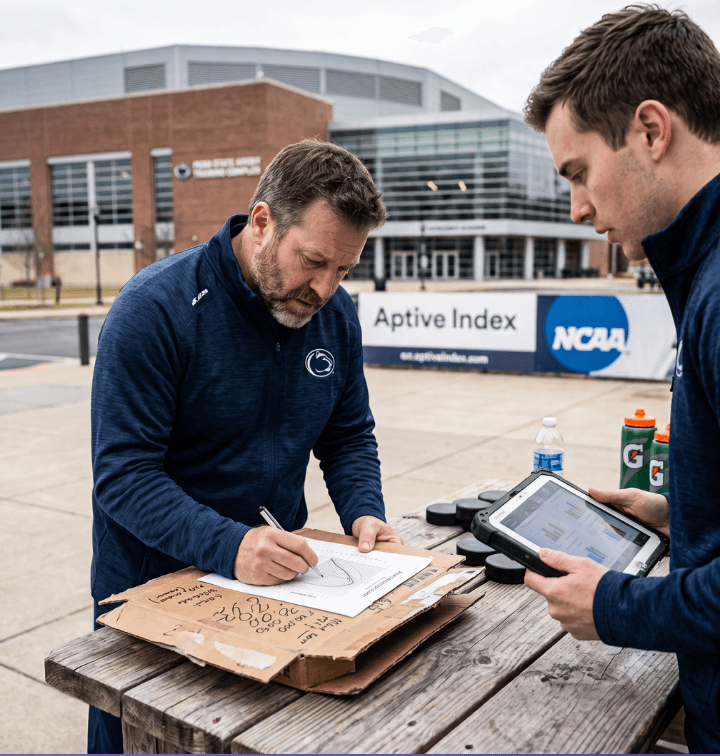
Aptive Index saw this play out during embedded work with a Division I hockey program in a conference playoff series. After a brutal double-overtime loss in Game 1, standard practice was unambiguous: rest the starting goaltender, start the backup. That's what most programs would do. It's what fans would expect. It's what a beat reporter would write without a second thought.

The behavioral data said the opposite. The coaching staff trusted it. The result was a 4-1 statement win the next night, a series-clinching victory two days later, and the program's first trip to the conference final four in five years.

That decision is worth studying closely, because it illustrates a principle every leader making high-pressure calls needs to understand: conventional wisdom is built for the average case. Behavioral data is built for the specific one.

Why the Conventional Rule Failed Here

Conventional decision-making — in sports, in business, in any high-stakes environment — runs on heuristics. Heuristics are patterns that are usually right because they're built from averages. "Rest your starter after a tough overtime loss" is a good rule most of the time, because most players carry emotional and physical fatigue forward in predictable ways.

The problem is that a heuristic describes the average player. It doesn't describe the one actually standing in front of you. This is exactly what behavioral profiling is built to catch: the moments when the average rule and the individual's actual wiring point in opposite directions.

The goaltender's psychometric profile showed a specific combination — minimal emotional carryover from setbacks, an activation level that didn't need external hype to reach competitive readiness, and a strong internal locus of execution. In plain terms: the previous night's loss wasn't something he needed to "get over." The data indicated he'd already filed it away, without the residual hesitation the conventional rule assumes every player carries. The backup, by contrast, showed more emotional volatility under exactly this kind of pressure. The rule built to protect most players would have worked against this one.

What Happens When the Data Is Only Half-Trusted

The failure mode most leaders fall into isn't ignoring data. It's applying it inconsistently — trusting it when it's convenient and overriding it when the moment feels urgent.

A separate case study, this one from a college baseball program, shows how expensive that inconsistency can be. A pitching deployment plan flagged one reliever specifically as a single-inning arm: his performance depended entirely on a defined ceiling and a hard exit point. The plan worked for seven innings. Then, holding a three-run lead, the coaching staff sent that same pitcher back out for a second inning — this time with no defined endpoint.

The result was immediate, and exactly what the data predicted: two walks, two balks, and a string of extra-base hits that turned a comfortable lead into a loss. Two other pitchers, profiled specifically for that exact high-leverage moment, sat unused in the bullpen the entire time.

The behavioral framework wasn't wrong. It was abandoned for one inning — and that one inning cost the game. Trusting data selectively produces the same outcome as not trusting it at all.

The Real Fix: Build the Decision Before the Moment Arrives

The lesson from both cases isn't "trust your gut less." It's "build the decision rule before the emotional pressure of the live moment can override it."

The hockey program didn't invent the goaltender decision in the moment. It came from a data check made first thing that morning — before the emotional weight of the previous night's loss could pull the staff toward the safer, more conventional choice.

The baseball case shows the inverse. That decision to leave the pitcher in was made live, under the pull of a comfortable lead, with no pre-committed exit point. This is the part leaders most often miss: behavioral science isn't only about profiling the people being deployed. It's about designing decision structures that protect against a leader's own wiring overriding the plan once the stakes rise.

A high-autonomy decision-maker who trusts his own read will find it psychologically difficult to reverse a call publicly once he's committed to it mid-crisis — even as the evidence mounts pitch by pitch. That's not a character flaw. It's a predictable pattern. Which is exactly why the exit point has to be fixed before the game, not negotiated during it.

Where This Shows Up Outside of Sports

Take the sports context away and the pattern holds. Every organization making a high-stakes call under pressure — who leads the crisis response, who takes the client call that could go either way, who gets the final say when a deal is on the line — faces the same fork: the expected pick, or the behaviorally correct one.

The leaders who get this right consistently aren't smarter in the moment. They've done the diagnostic work before the moment arrives, so the decision doesn't have to be invented under pressure. By the time the room is watching, the hard thinking is already finished.

What Leaders Can Do This Week

  1. Separate the rule from the exception before you need to. Identify your team's default "conventional wisdom" calls, then check which specific people the data suggests are exceptions to them.
  2. Pre-commit high-pressure decisions. Define exit points, role limits, and deployment structures before the pressure moment — not during it, when your own decision-making bias is at its highest.
  3. Treat behavioral frameworks as a system, not a menu. Partial application isn't a smaller version of the plan working. It's the plan failing, in one specific place, at the worst possible time.
  4. Profile your own decision-making wiring. Know how you personally behave once you've committed to a call under pressure, and build structures that don't depend on you reversing course in real time.
  5. Make the data check routine, not exceptional. The clearest results come from daily, habitual use of behavioral insight — not a report pulled out only when a crisis is already underway.

The teams that win in the moments that matter most aren't the ones with better instincts. They're the ones who did the work in advance to know exactly when their instincts should be overruled.

Aptive Index applies behavioral science to athletic and organizational performance, translating psychometric data into deployment, coaching, and leadership decisions that hold up under pressure.

You may also like

Most organizations use behavioral science to hire better.

They assess candidates. They build teams. They map drives to roles.

And then a client signs, and all of that rigor disappears.

Same onboarding for everyone. Same communication cadence. Same success playbook. As if understanding how people are wired only matters inside the organization.

It doesn't stop there.

The Gap Nobody Talks About

Leaders believe client success is about delivering on promises.

It is. But that's only half of it.

The other half? Understanding what creates genuine trust for each individual client - knowing that trust is personal, not procedural.

You already know this about your team. Your high Consistency hires need advance notice before change. Your high Precision people need standards respected. Your high Sociability leaders need connection, not just efficiency.

Your clients are wired the same way.

Some need to feel in control. Others need to feel included. Some need data and proof before they move. Others need someone to actually pick up the phone.

One-size-fits-all onboarding, one-size-fits-all communication, one-size-fits-all success plans; they all make the same assumption: that your clients are wired like you.

They're not.

I've watched organizations lose great clients with no clear explanation. The product delivered. The team showed up. Nothing went wrong.

Except the client never felt understood. And eventually, "nothing wrong" wasn't enough.

What the Drive Profile Actually Tells You

The same behavioral patterns you use internally? They show up in every client relationship.

A client with a high Influence drive needs autonomy. They want to feel like a partner making decisions, not an account being managed. Over-process them and they'll start looking for the exit.

A client with a high Consistency drive needs predictability. They need to know exactly what to expect and when. Surprise them with a change - even a good one - and you've broken something harder to repair than a product bug.

A client with a high Sociability drive needs connection. Not just responsiveness - relationship. They want to feel personally valued, not just serviced efficiently.

A client with a high Precision drive needs accuracy and transparency. Show them vague outcomes without the data underneath, and you've lost credibility — possibly permanently.

When your entire client experience is designed through one behavioral lens, you're building loyalty with clients who share your wiring. And quietly losing everyone else.

The Moments That Actually Matter

I'm not talking about NPS scores or QBRs.

I'm talking about the moments inside the relationship where trust is either built or quietly eroded:

  • When they've just committed and buyer's remorse sets in
  • When they're learning your system and feeling overwhelmed
  • When they hit a milestone and nobody acknowledges it
  • When they're deciding whether to refer someone, and whether you've treated them like a partner or a revenue line

At every one of those moments, the question is the same: Does this client feel understood?

Not because you've typed them into a segment. Because you've designed for how they're actually wired.

You Already Have the Framework

This is where it gets practical.

If your organization is already using behavioral science to build better teams, you're closer than you think to doing this with clients too.

The drives don't change when someone becomes a client. The expectations they bring into a relationship, what builds trust, what breaks it, what makes them feel genuinely valued, those are shaped by the same wiring you're already measuring.

The question is whether you're using that lens inside the building only, or whether you're extending it to every relationship that matters.

Start by asking a different question about every touchpoint in your client journey:

Does this work for the client who needs autonomy and the one who needs structure?
Does this celebration land for the person who wants recognition and the one who prefers quiet acknowledgment?
Does this cadence serve the client who wants frequent contact and the one who finds it suffocating?

When you design backward from genuine understanding of behavioral diversity, the client experience stops feeling like a program.

It starts feeling like you actually know them.

And that's when loyalty stops being something you chase. It becomes something that follows you.

You're already using behavioral science to build better teams. Are you using it to build better client relationships too?

The Player Everyone Gave Up On

Maya had the mechanics.

Clean footwork. Textbook shot release. Unstoppable in practice.

But game time changed everything.

Shoulders tensed. Decision-making collapsed. By the fourth quarter, she'd be benched.

Her coach tried everything. Visualization. Positive self-talk. Confidence building.

Nothing worked.

Because Maya's problem wasn't emotional intelligence. It was nervous system dysregulation.

Why EQ Isn't Enough

EQ identifies what an athlete is feeling. It can't explain why their body betrays them under pressure.

Research shows 65% of performance breakdown stems from autonomic nervous system dysregulation. Not lack of skill. Not lack of confidence.

When cortisol and adrenaline flood the system, the prefrontal cortex goes offline.

No amount of "stay calm" overrides that physiological state.

The Hidden Drivers

Maya's coach assessed her using the Aptive Index.

Two attributes explained everything:

High Intensity: Her internal motor ran fast. In practice, this made her explosive. In competition, it pushed her into chronic over-arousal.

High Emotional Resonance: She didn't just experience mistakes - she carried them. A first-quarter turnover echoed into the second.

These aren't personality quirks. They're stable neurological patterns that require different interventions.

The Breakthrough

Maya's coach stopped treating anxiety as a mindset problem.

He started coaching her nervous system:

  • Pre-competition: 5 minutes of box breathing
  • Between plays: Touch sideline, exhale twice, say "Next"
  • Timeouts: 30 seconds eyes closed, breath-focused

Within four games, her shooting percentage under pressure jumped from 31% to 58%.

Not because she got more skilled. Because her body had tools to stay regulated.

The Real Unlock

EQ says: "Maya is anxious."

The Aptive Index says: "Maya's high Intensity is pushing her into sympathetic overdrive, and her high Emotional Resonance means she's still processing the mistake from two plays ago. She needs a parasympathetic reset before she can execute."

One is observation.

The other is intervention.

Maya didn't need more confidence. She needed nervous system regulation.

Once her coach could see what EQ couldn't measure, everything changed.

That's where championship performance lives, not in what you can see, but in what you finally learn to unlock.

AUSTIN, Texas (November 20, 2024)—Aptive Index, a leader in psychometric assessment and behavioral insights, is thrilled to unveil the results of its most comprehensive validation study to date, demonstrating the exceptional accuracy, reliability, and relevance of its innovative tools. This rigorous research further solidifies Aptive Index as a trusted partner for CEOs, business leaders, and HR professionals aiming to transform their hiring and team-building strategies.

The comprehensive study involved over 400 participants and integrated data from thousands of prior assessments, solidifying Aptive Index’s position as a leader in psychometric evaluation. Results demonstrated that Aptive Index consistently outperforms industry benchmarks in measuring personality and work-style attributes essential for successful organizational alignment.

Aptive Index uses seven key behavioral and hardwired work-style traits to help businesses match people with roles where they will thrive. This approach goes beyond traditional methods by looking at how someone’s natural tendencies align with the needs of a job or team. The result is lower turnover, stronger team connections, and more satisfied employees.

The study demonstrated exceptional reliability metrics across all key indicators. The ISCP Framework — Influence, Sociability, Consistency, and Precision — showed outstanding composite reliability scores ranging from 0.831 to 0.889, significantly exceeding industry standards. These core measurements were further validated by strong test-retest correlations, with Sociability showing particularly robust stability at 0.922. Factor analysis revealed high construct validity with Kaiser-Meyer-Olkin (KMO) values between 0.781 and 0.892, confirming the assessment's precision in measuring distinct attributes. Collectively, these metrics establish the Aptive Index as one of the most reliable and scientifically validated tools available for talent optimization and strategic hiring decisions.

Further findings revealed the Aptive Index’s impact on reducing employee turnover, a key challenge for businesses worldwide. By aligning candidates with roles suited to their strengths and natural work styles, the assessment directly addresses the costly consequences of turnover, which can range from 30% to 150% of an employee’s annual salary. Aptive Index enables companies to foster more cohesive teams and improve retention rates by ensuring the right fit for every role.

Aptive Index also excels in promoting diversity, equity, and inclusion (DEI) through its assessments. Rigorous analysis confirmed that the platform is free from demographic bias, supporting fair and inclusive hiring practices. This feature empowers organizations to build diverse teams while maintaining the highest standards of accuracy and integrity.

“Our mission at Aptive Index is to help organizations make smarter, data-driven decisions that empower individuals and teams,” said Jason P. Carroll, Founder and CEO of Aptive Index. “This validation study demonstrates not only the precision of our platform but also the tangible benefits it brings to the workplace, from reducing turnover to promoting inclusivity.”

Click here to download the full validation documentation. [Aptive Index Comprehensive Validation Report.pdf]

Aptive Index uses cookies to offer
you a better experience.